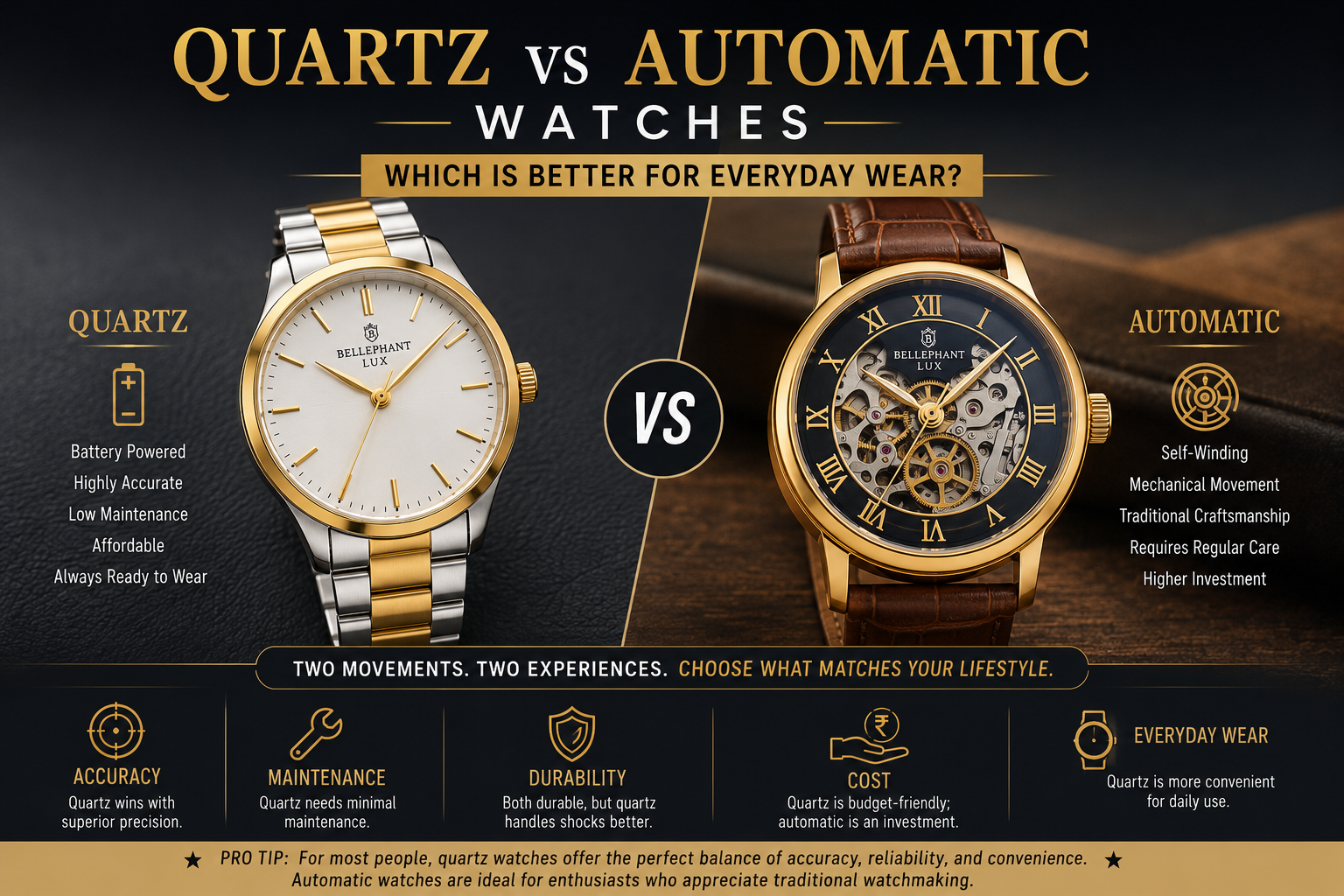
When buying a luxury watch, one of the first questions you’ll come across is whether to choose a quartz or an automatic movement. While both have their own strengths, understanding how they work and which one suits your lifestyle can save you from making an expensive mistake.
Many first-time buyers assume that automatic watches are always better because they’re often associated with luxury brands. On the other hand, quartz watches are sometimes misunderstood as “basic” simply because they’re battery-powered. The truth is far more interesting.
Today, some of the world’s most respected watchmakers produce both quartz and automatic watches, each designed for different types of users. The best choice isn’t about prestige—it’s about your daily routine, maintenance expectations, budget, and personal preferences.
Whether you’re buying your first premium timepiece or expanding your collection, this guide explains everything you need to know about quartz and automatic watches, helping you decide which movement is truly better for everyday wear.
What Is a Quartz Watch?
A quartz watch is powered by a small battery that sends electricity through a quartz crystal. When electricity passes through the crystal, it vibrates at a highly consistent frequency of 32,768 times per second. These vibrations are measured by an electronic circuit, allowing the watch to keep extremely accurate time.
Quartz technology transformed the watch industry in the late 20th century by making accurate timekeeping affordable and accessible. Today, quartz movements are widely used in premium fashion watches, sports watches, dress watches, and everyday luxury timepieces because of their exceptional precision and reliability.
Unlike mechanical watches, quartz watches don’t rely on gears powered by a spring. This means there are fewer moving parts, reducing wear and making them easier to maintain.
What Is an Automatic Watch?
An automatic watch is a type of mechanical watch that doesn’t use a battery. Instead, it is powered by a tightly wound mainspring. As you move your wrist throughout the day, a weighted rotor inside the watch rotates and continuously winds the spring, providing energy to keep the watch running.
Automatic watches are admired for their craftsmanship and engineering. Hundreds of tiny components work together in perfect harmony, making them fascinating pieces of mechanical design.
However, if the watch isn’t worn regularly, the stored energy eventually runs out, causing the watch to stop. Most automatic watches offer a power reserve of approximately 38 to 80 hours, depending on the movement.
Accuracy: Which Movement Keeps Better Time?
If accuracy is your top priority, quartz watches are the clear winner.
A quality quartz movement typically varies by only ±15 seconds per month, making it one of the most precise forms of timekeeping available. Because it relies on electronic regulation rather than mechanical components, it remains consistently accurate regardless of daily use.
Automatic watches, while impressive from an engineering perspective, naturally lose or gain a few seconds each day due to the complexity of their mechanical parts. Even well-made automatic movements commonly vary by ±5 to ±20 seconds per day, depending on the quality of the movement and how it’s regulated.
For professionals, students, travelers, and anyone who depends on precise timekeeping, quartz watches provide unmatched reliability.
Maintenance Requirements
One of the biggest differences between these two movements is maintenance.
Quartz watches require very little attention. Aside from replacing the battery every few years, they generally continue operating accurately without regular servicing. This makes them ideal for busy lifestyles where convenience matters.
Automatic watches, however, require more care. Since they contain intricate mechanical components, manufacturers typically recommend servicing them every three to five years. If left unserviced for extended periods, worn lubricants and mechanical friction may affect performance.
Additionally, if you don’t wear an automatic watch regularly, you’ll often need to reset both the time and date before wearing it again.
For everyday users, quartz movements provide a far more practical ownership experience.
Durability for Everyday Wear
Everyday watches experience bumps, vibrations, temperature changes, and continuous movement. Durability therefore becomes an important consideration.
Quartz watches generally perform better under daily conditions because they contain fewer moving mechanical components. Their simple construction makes them more resistant to minor shocks and everyday wear.
Automatic watches, while durable, contain hundreds of precision-engineered parts working together. Although modern automatic movements are built to withstand regular use, severe impacts can affect their accuracy more easily than quartz movements.
If your watch will accompany you to work, travel, family gatherings, and daily activities, quartz offers outstanding durability with minimal concern.
Convenience Matters
Imagine picking up your watch on Monday morning after not wearing it over the weekend.
With a quartz watch, you simply put it on and go.
With an automatic watch, you may discover it has stopped running. You’ll need to wind it, reset the time, adjust the date, and sometimes wait until it’s fully powered before wearing it.
While enthusiasts enjoy this ritual, many people simply want a watch that’s always ready.
For professionals with busy schedules, convenience is one of quartz’s greatest advantages.
Cost and Long-Term Value
Automatic watches are generally more expensive because of their complex mechanical construction. Hundreds of tiny components require precise manufacturing and skilled assembly, increasing production costs.
Quartz watches deliver exceptional value by offering premium aesthetics, reliable performance, and excellent accuracy at a much more accessible price.
This is one reason why many premium lifestyle brands—including Bellephant Lux—choose high-quality Japanese Quartz movements for their collections. Customers receive dependable performance, elegant design, and everyday practicality without paying for mechanical complexity they may not need.
Which Watch Is Better for Everyday Wear?
The answer depends on your lifestyle.
Choose a Quartz Watch if you:
- Want exceptional accuracy.
- Prefer low maintenance.
- Need a reliable everyday watch.
- Wear your watch daily for work or travel.
- Want premium quality at an accessible price.
- Don’t want to reset your watch frequently.
Choose an Automatic Watch if you:
- Appreciate traditional watchmaking.
- Enjoy mechanical engineering.
- Don’t mind regular servicing.
- Rotate between multiple watches.
- Value craftsmanship over convenience.
For the vast majority of people, quartz watches provide the better everyday experience because they combine precision, durability, affordability, and simplicity.
Why Bellephant Lux Uses Japanese Quartz Movements
At Bellephant Lux, every watch is designed to combine timeless elegance with dependable everyday performance.
Instead of focusing solely on prestige, Bellephant Lux prioritizes reliability, ensuring customers receive watches that perform consistently while maintaining a premium appearance.
Japanese Quartz movements are internationally recognized for their precision and durability, making them an ideal choice for professionals, entrepreneurs, students, and anyone looking for a sophisticated timepiece they can wear every day.
Collections such as The Ivory Edition – Gold Collection, The Savannah Series, The Luna Tusk – Rose Gold Edition, and The Serengeti Rose reflect this philosophy by combining elegant design, premium stainless steel construction, refined finishing, and reliable timekeeping in watches designed for modern lifestyles.
Final Thoughts
The debate between quartz and automatic watches has existed for decades, but there isn’t a universal winner. Each movement serves a different purpose.
Automatic watches celebrate traditional craftsmanship and mechanical artistry, making them appealing to collectors and enthusiasts.
Quartz watches, however, excel where most everyday users need them to—accuracy, convenience, durability, and low maintenance.
If you’re searching for a luxury watch you’ll wear to work, family events, business meetings, vacations, and everyday outings, a high-quality quartz watch is often the smarter investment. It offers dependable performance, timeless elegance, and outstanding value without demanding constant attention.
Ultimately, the best watch isn’t determined by its movement alone. It’s the one that complements your lifestyle, reflects your personality, and gives you confidence every time you wear it.
Frequently Asked Questions
1. Is a quartz watch more accurate than an automatic watch?
Yes. Quartz watches are significantly more accurate because they use a vibrating quartz crystal regulated electronically, typically deviating by only a few seconds each month.
2. Why are automatic watches more expensive?
Automatic watches contain hundreds of precision-engineered mechanical components that require specialized manufacturing, assembly, and servicing, making them more costly to produce.
3. How long does a quartz watch battery last?
Most quartz watch batteries last between 2 and 5 years, depending on the movement and watch features.
4. Are Japanese Quartz movements reliable?
Absolutely. Japanese Quartz movements are known worldwide for their accuracy, durability, and low maintenance, making them one of the most trusted choices for everyday luxury watches.
5. Which movement is best for everyday wear?
For most people, quartz is the better option because it offers excellent accuracy, minimal maintenance, dependable performance, and greater convenience for daily use.